
What’s the Point of Saving Time, Anyway? A Lesson from a Famous Father-in-Law
It’s time to introduce our new blog series: Homesteading with the Masters!
One of the many benefits of farming is that it’s drawn us into the “great conversation” of Western thought in a whole new way.
Many of the great writers and thinkers of Western Civilization lived much closer to the land than the average person in modern America. Some wrote directly about farming. Others wrote from the context of a certain amount of experience with the tasks of handling animals and raising food. Sharing to some extent in this experience that they took for granted has given us new insights into many of their writings.
This ongoing blog series will focus on homesteading-related quotes from the great writers of Western Civilization, considered in the context of our own experiences as farmers.
Today we’re kicking it off with a quote from one of the world’s most beloved farming writers: Laura Ingalls Wilder. Her book, Farmer Boy, describes the childhood of her husband, Almanzo Wilder, on a farm in upstate New York. Let’s listen in to a conversation between nine-year-old Almanzo and his father:
Almanzo asked Father why he did not hire the machine that did threshing. Three men had brought it into the country last fall, and Father had gone to see it. It would thresh a man’s whole grain crop in a few days.
Laura Ingalls Wilder, Farmer Boy.
“That’s a lazy man’s way to thresh,” Father said. “Haste makes waste, but a lazy man’d rather get his work done fast than do it himself. That machine chews up the straw till it’s not fit to feed stock, and it scatters grain around and wastes it.
“All it saves is time, son. And what good is time, with nothing to do? You want to sit and twiddle your thumbs, all these stormy winter days?”
Excuse us for a second while we pick ourselves up off the floor and recover from our utter shock at this flagrant disregard for the importance of saving time.
We’ll also preface our analysis by pointing out that Almanzo’s Father must have had some kind of prophetic powers. For “sit there and twiddle your thumbs” is a delightfully accurate description of the physical action involved in operating a smartphone. And you don’t need us to point out that operating a smartphone is something many people in our culture spend quite a bit of time doing.
Since, you know, they don’t need to thresh their own wheat.
But the real reason this quote is striking is that it reveals a perspective that is refreshingly, distinct from our own fast-paced, efficiency-obsessed world. We employ any number of machines that save us time, and feel like reasonably enlightened people while we’re doing it. It comes as a bit of a shock to hear someone questioning the pre-eminent value of “saving time.”
But with all our efficiency, are we actually better off?
Let’s dig a bit deeper.
If you, like us, have a rather hazy grasp on what threshing is, here’s a quick reminder. It’s the task of separating grains of wheat from the husks and the stalks. If you’re doing it by hand, like Almanzo and his father, the basic process is to spread a layer of wheat on the barn floor and hit it with a stick.
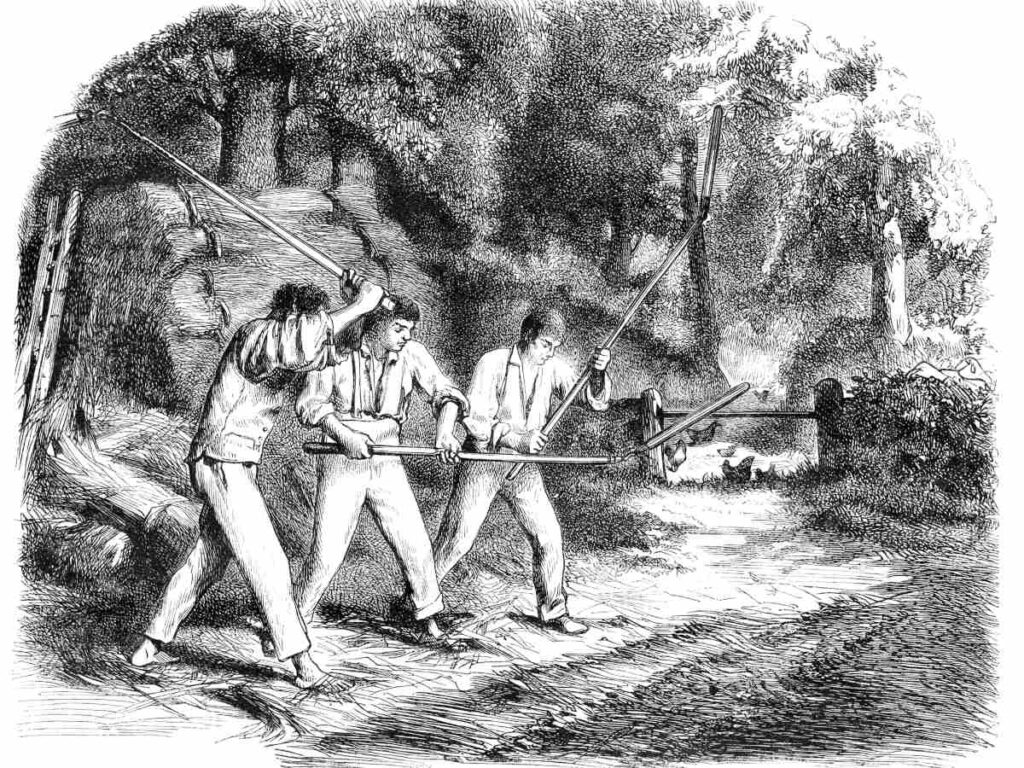
In Farmer Boy this repetitive task extended throughout the winter. It’s not surprising that Almanzo might have wondered why Father wouldn’t use a machine to get the work done with less than half the trouble.
After all, we, too, can think of a lot of things you could do with your winter hours other than whack stalks of wheat with a stick for days on end.
Almanzo’s father, for that matter, wasn’t exactly short on things to do. It should be noted that he also had “Hand cut a year’s supply of giant blocks of ice out of a frozen river and transport them by horse-drawn sleigh to the ice-house on the farm” on his to-do list.
He also had the responsibility of getting up at midnight on bitterly cold winter nights (-40F and lower!) to chase his cows around the barnyard with a whip so they didn’t freeze to death.
As a side note, we’ll point out that our cows did just fine during a couple of nights of below zero temperatures when we felt like absolute heroes for going out and milking in the morning. So, if it’s cold enough for cows actually to be in danger of freezing to death . . . it must be miserable beyond words to be out there at midnight chasing your cows around the barnyard.
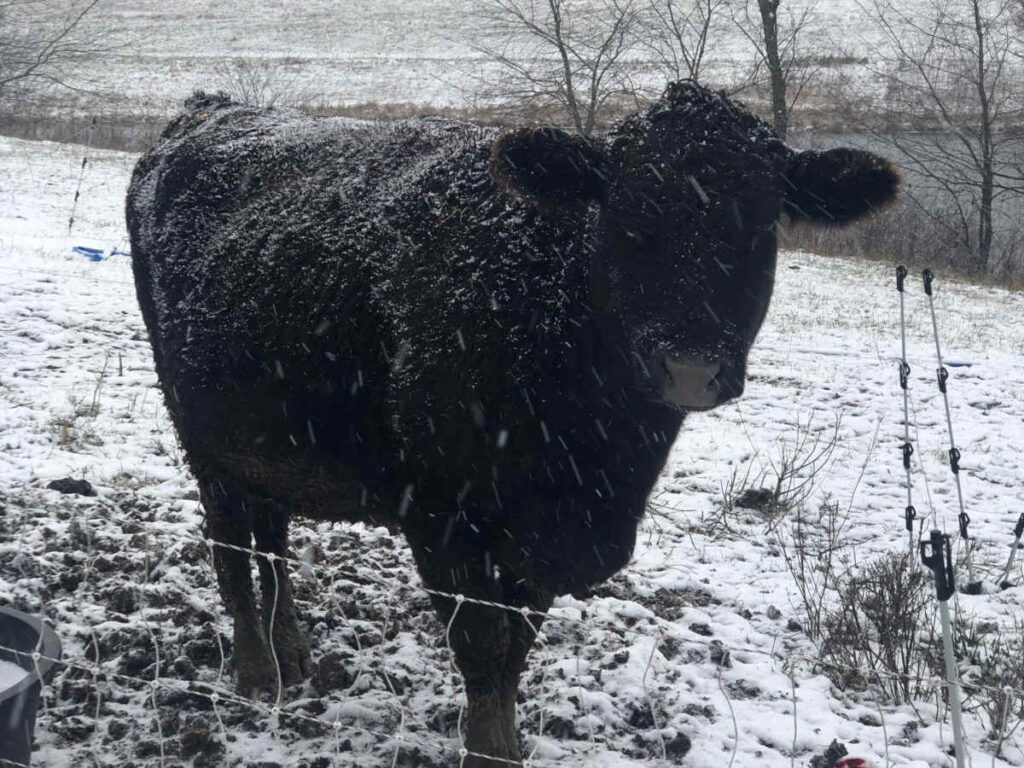
“Take a nap” might absolutely be high on our list of things to do in the daytime if we were up at midnight running around the barnyard with a bunch of cows in ridiculously cold weather. That is if we didn’t have to, you know, thresh our own wheat by hand.
So can we find the wisdom of the ages in this literary selection? Or should we just be patting ourselves on the back for being quite a bit more efficient than this old-time New England farmer?
Finding Work that’s Worthwhile
The reason we found this quote worth writing about is that it calls us to reconsider our culture’s approach to manual labor. A major emphasis in our culture is on increasing efficiency. Usually the goal is either to get more work done, or to increase one’s available free time.
But this quote prompts us to consider a different perspective. Too often, we approach our work with the sense that we would like to get it over with. What if, instead, we asked: “How can I fill my days with work that is, in itself, fulfilling?”
Can we find work that engages our bodies? That our children can do alongside us? That makes us physically stronger? If so, perhaps this work itself could become something not to “get done” as quickly as possible, but in which to take delight.
Threshing your wheat by hand may not be glamorous. But if you read the full “threshing” chapter in Farmer Boy, you’ll learn that the barn was warm and the work pleasant. And more, that through sharing intimately in the work of providing food for the family, the boy became a man.
Consider that the vast majority of fathers in modern Western culture do not need to spend a winter in the barn doing the physical work of threshing wheat with their sons. Instead, they “get” to sit still in front of computers for most of their waking hours at some distance from their families.
Let’s also remember that our culture not only accepts but admires the concept of “gym memberships.” Many thousands of hours are spent in gyms performing actions that are probably about as repetitive as threshing wheat. A significant difference would be that a workout at the gym is a lot less productive in terms of food thereby provided for one’s family. In fact, the proliferation of such gyms all over this country would probably be as bemusing to Almanzo’s Father as his insistence on working by hand might be to us.
In choosing to thresh his wheat by hand, Father is not foolishly choosing drudgery. He’s choosing to spend his days in shared labor with his son. To stay strong and vigorous. To engage his physical strength in the noble task of providing food for his family.
In Conclusion
The purpose of this post is not to convince our readers to drop everything, head out to the barn, and start taking out their frustrations on the nearest defenseless sheaf of wheat. At risk of outing ourselves as fake farmers, we’ll admit that we neither grow nor thresh our own wheat.
Also, despite the fact that we’ve been lucky enough to make our lives on a family farm, Matthew still works a full time job on the computer. So we’re also not here to deride those who make an honest living working on a computer in an office.
As a final disclaimer, we don’t want to bash the ideas of exercise and working out.
The goal is simply to present a perspective that is all too easily lost in the whirl of activity that characterizes many modern lives. Physical labor can be a contributor, rather than an obstacle, to human flourishing and family unity.
After all, the single factor that attracted us most strongly to farming was an idea not too distant from that contained in this quote. It was the idea that the ability to work hard alongside our children was, in itself, a good worthy of pursuing.
With this in mind, we’d have to agree that threshing wheat by hand with your son is a great way to spend rather a lot of stormy winter days. And if your future daughter-in-law happens to be a great American writer, you may even get famous for doing it.
Nevertheless, we would not want our readers under the illusion that we’re out there doing all of our work by hand.
So stay tuned for the next post, where we’ll be completing our consideration of this quote with a list of three machines that we’ve found are worth having for saving our sanity while farming.

This is wonderful! Always glad to see a Farmer Boy tie-in, especially after revisiting the book this year with my boys.
Glad you enjoyed it!