
The Four-Day Farming Frenzy
It’s been an eventful few days on the farm.
Half a week filled with a dizzying whirl of animal arrivals and departures, not to mention unexpected complications and fortuitous coincidences.
The kind of week that leaves us wondering if we are the conductors of a complex but harmonious symphony or the ringmasters of a three-ring circus. Or maybe none of these, but simply clinging on for dear life to the wild ride that is family farming.
We emerge from the fray with a beefy steer in production and a rollicking tale to tell.
Pull up your chair and enjoy. But be warned: your head may start spinning at some point in this narrative.
Sunday – the Birth of Blossom
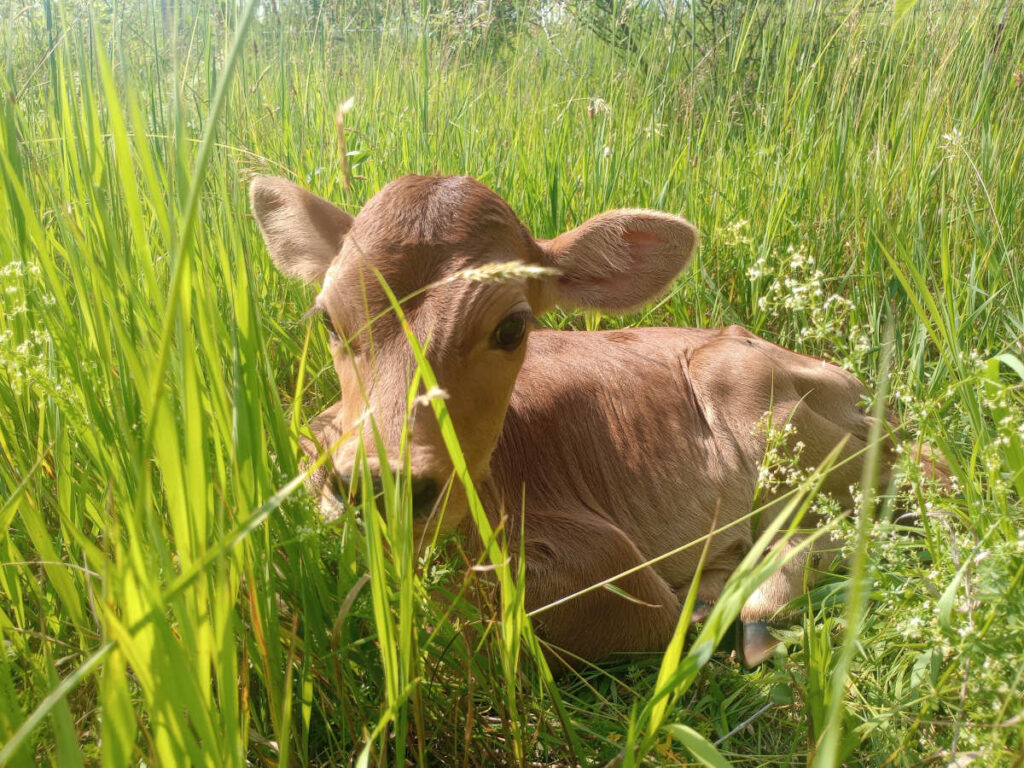
The week got started with some predictable excitement as our milk cow, Clover, gave birth precisely on her due date.
It was one of those “walk-out-into-the-field-and-oh-look-there’s-a-baby-animal” type of births.
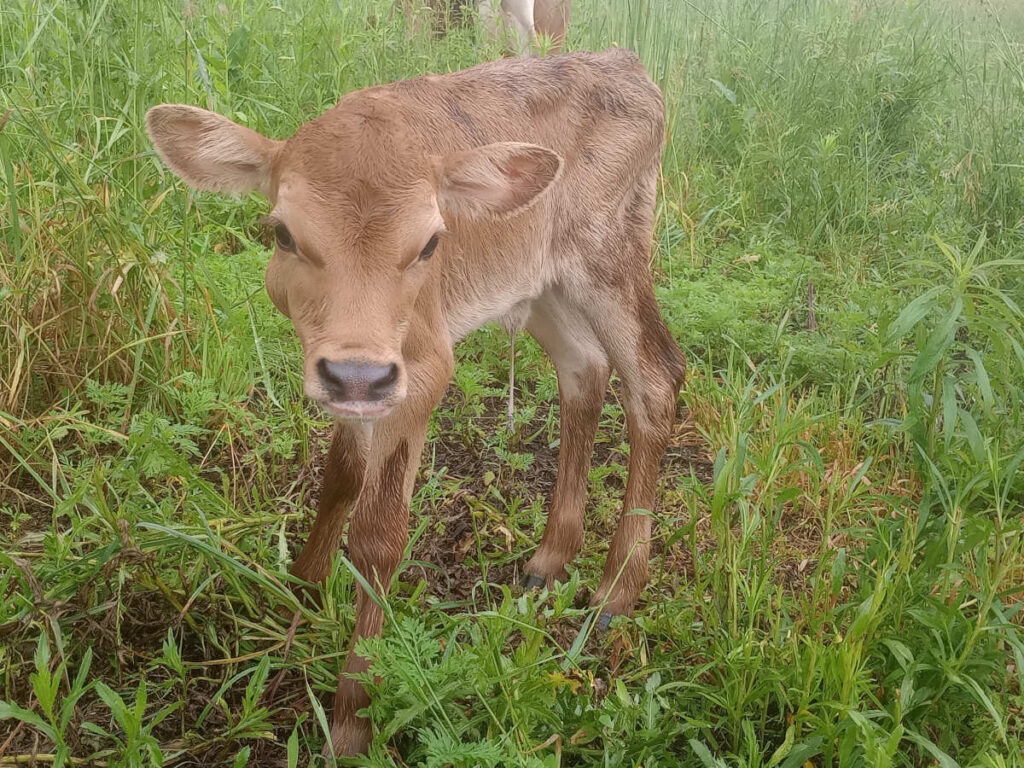
In fortuitous coincidence number one, the calf arrived on the feast of Pentecost. This was significant because the very first calf we ever bought was also born on Pentecost, and even named for the feast day by his original owners. Finding this too much of a mouthful, we shortened it to Penny and spent many a frustrated hour chasing him around our farm.
Anyway, it was fun to welcome another calf on the very same feast day.
The suggestion of “Penny the Second” as a name was swiftly and soundly voted down by the younger members of the family in favor of Blossom.
We brought Clover in and milked her that afternoon. Mother and baby were both doing great. So far so good.
Monday – The Day of 8000 Moos
Here’s where things get complicated.
Well, actually, they had been complicated for a while.
You see, Clover is our most prodigious milk producer, and while we thought we had followed the common practice of most dairy farmers by drying off her milk supply several months before Blossom’s birth, it turns out that drying off your super-productive Jersey cow is surprisingly difficult.
You just . . . stop milking . . . is how we thought it was done.
We isolated her from the rest of the herd for three weeks towards the end of winter, with no udder contact from us or any calves. Her udder looked like a deflated balloon. A great sign.
But spring grasses started growing and she started eating them. . .
Suddenly her udder was not only swollen and massive, but also dripping milk.
Uggghhh.
This unexpected milk production posed a bit of a problem. We couldn’t just ignore it without running the risk of her developing an infection.
But we also didn’t really want the milk.
- Milking three cows is a bit much
- A cow that is producing milk within six weeks or so of giving birth is producing colostrum. This may be a super food, but it’s also . . . not very tasty.
We didn’t really want to be doing all the work of milking an extra cow for milk nobody would want to drink.
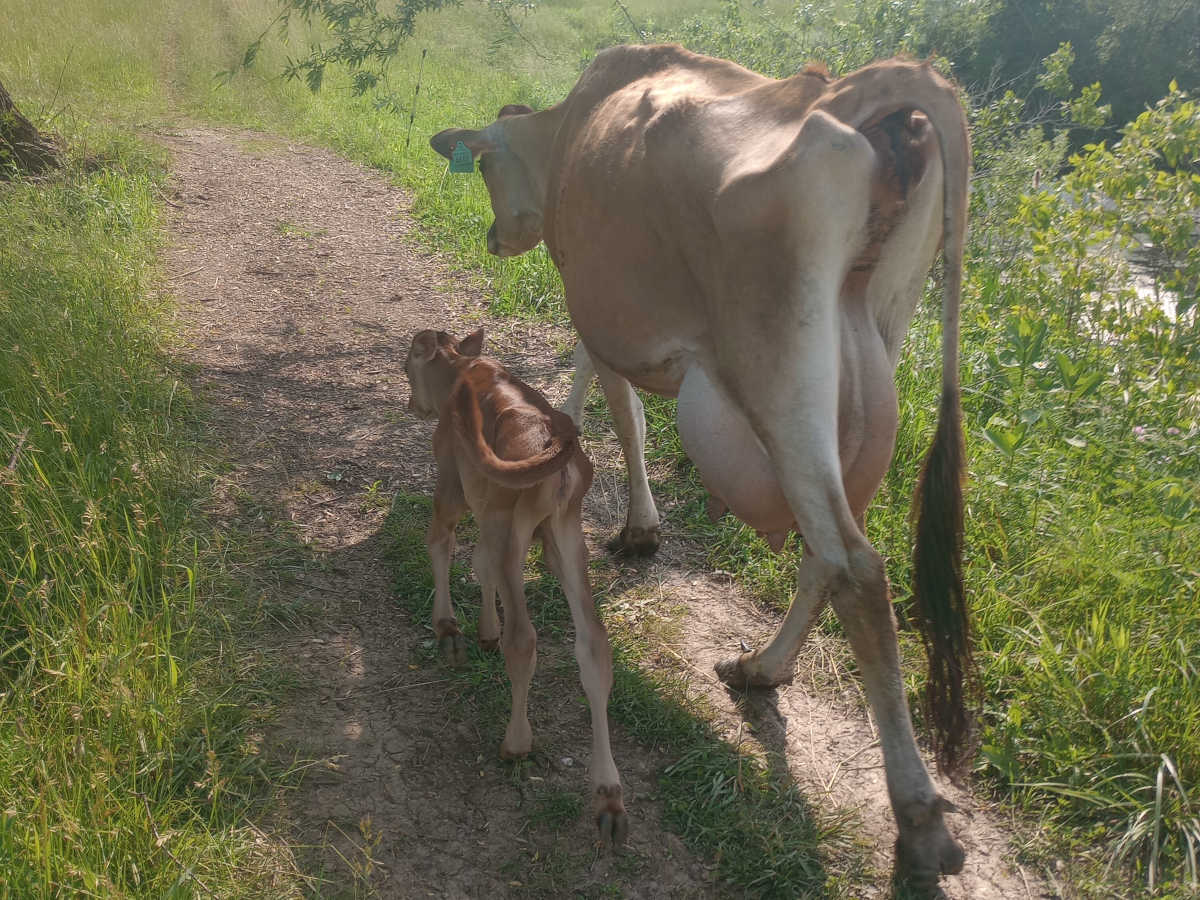
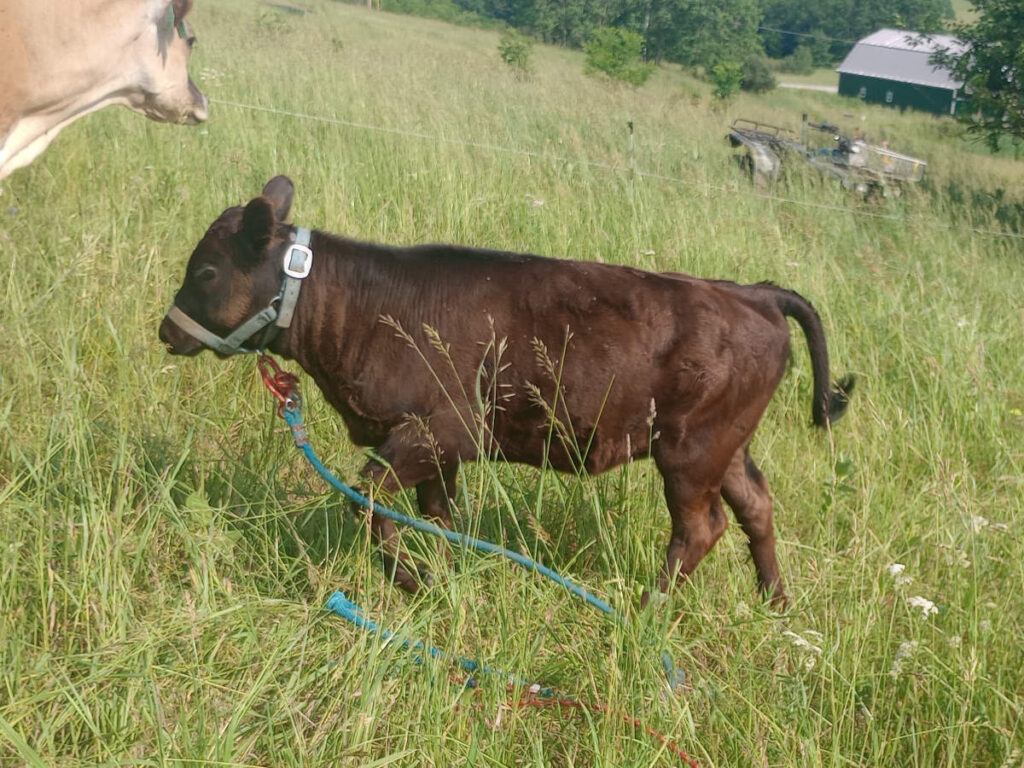
The solution we arrived at was to assign the task of “milking” Clover to our six month old calf, Rosie. Rosie, by the way, was not Clover’s actual calf, but belongs with our other milk cow, Judy.
Many cows, including Clover, seem to be fine with nursing not only their nearest and dearest, but also any member of the bovine species who happens to stroll over and start sucking. This personality trait may make the cow “nice” but it also makes things complicated for farmers. In fact, we suspected that some unsanctioned (by us) nursing on Rosie’s part had compounded the problem we now faced.
We warned you your head might be spinning.
Anyway, Rosie was very happy to take the job of keeping Clover’s udder empty for us, and grew big and strong on lots of colostrum-milk.
But the birth of Blossom marked the time for her to be ousted. You know, so Clover’s own baby could have some milk.
It shouldn’t cause too much drama, right?
After all, Clover isn’t Rosie’s real mother.
Rosie should simply be grateful for her six weeks of 24/7 access to fresh milk on tap and move on with life.
Rosie is in many ways a very nice calf. Unfortunately she did not take this enlightened view of the new arrangement.
She mooed. Without stopping. All. Day. Long. Matthew tried to time the interval between moos. He had trouble finding a time of silence when he could count to ten. This worked out to somewhere around a whopping eight thousand moos over the course of the day.
Yes eight thousand. About 720 moos an hour for twelve hours.
Can you imagine mooing eight thousand times?
What about listening to eight thousand moos?
That evening, we had to bring Clover into the barn to milk. When we went out to get her, we found that our lovely dairy herd, now consisting of Clover, Mercy, and Judy, were on what you might call the “rattled” end of the cow equilibrium scale.
Mercy was upset because we had taken away her calf, Martha, which we routinely do in the evenings so that there’ll be milk for us in the morning.
Clover was upset because even though she had her own baby with her, she also wanted Rosie. Honestly she didn’t even seem to appreciate the fact that her newborn calf was skipping happily around. Clover may have the nicest personality of all our cows. What she does not have is intellectual prowess.
Judy was upset . . . we’re not sure why. She’s not used to having Rosie with her. Maybe it was just the cumulative effect of listening to another animal moo eight thousand times.
There are several different kinds of noises cows can make. There’s gentle lowing, there’s contented grunting. There’s also what we’ll call the moo-scream.
The moo-scream is a prolonged and loud moo that rapidly increases in both volume and pitch while the cow arches its neck and opens its mouth to the fullest extent possible.
MOOOOOO.
Sometimes our cows will throw the odd moo-scream at us.
On Monday night ALL THREE were moo-screaming at us at the same time, quickly adding their own contributions to the day’s moo total.
Symphony or three-ring circus?
Tuesday – Let’s Throw in 50 Chickens
Well newborn calves and disgruntled big calves certainly make life exciting. But as it happened, Blossom was not fated to be the only new arrival on the farm that week.
We had previously made arrangements with an Amish farmer to buy fifty three-week-old meat chickens from him.
He delivered them the very next evening.
Getting ready for their arrival didn’t cause too much upheaval, as we already had all the equipment we needed from years before.
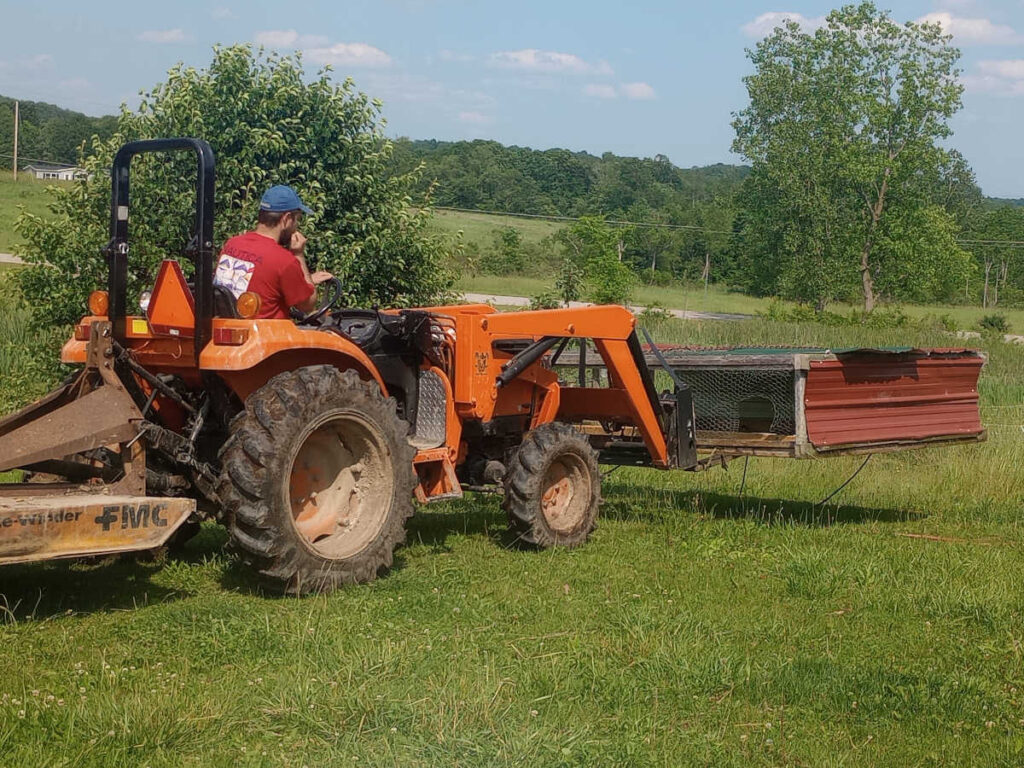
It did, however, require the somewhat delicate task of lifting up our sort-of-portable chicken coop with our tractor and moving it down the public road several hundred yards to bring it to the part of our farm where we wanted it.
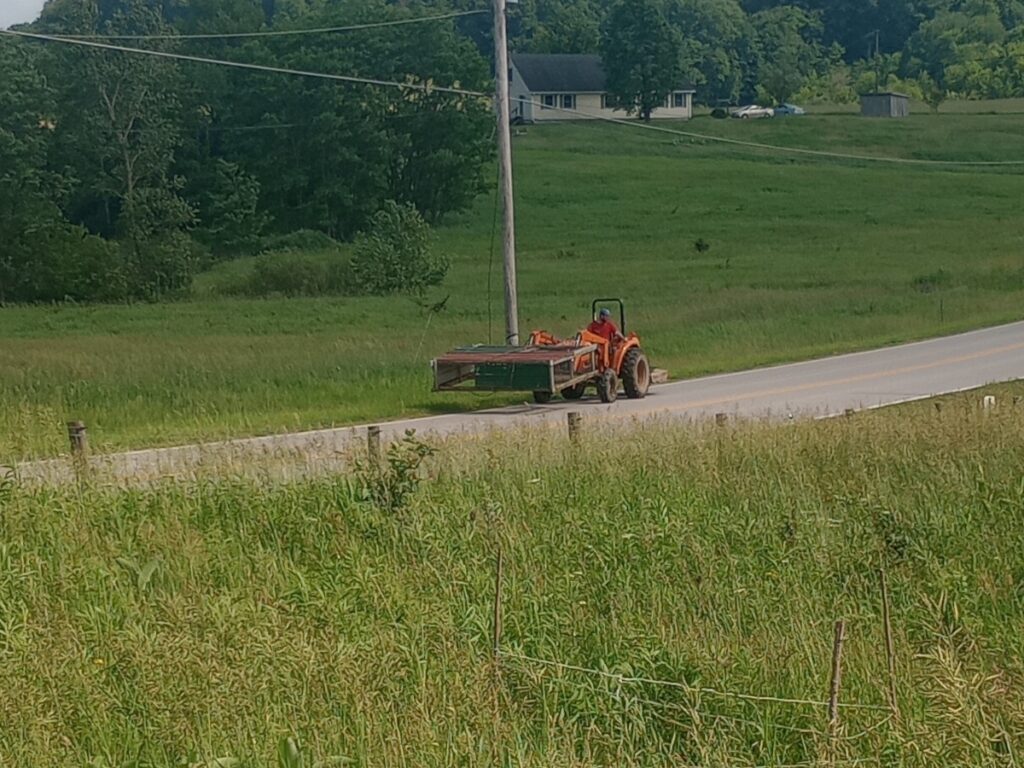
Then we had to turn around and milk Clover again (milking time comes twice as often when there’s a newborn calf).
Nevertheless, we emerged from the previous few days of milking, wiping sweat from our foreheads but triumphantly waving a five gallon bucket full of “not-ready-for-the table” colostrum-y milk.
We’ve found that nothing makes meat chickens get “meaty” as effectively as surplus milk. Skim-milk, buttermilk, “colostrum-y” milk. Whatever we can’t use ourselves. Having extra milk when we’re raising meat chickens is a match made in heaven.
By this point Rosie had calmed down quite a bit and harmony was returning to the farm. But the rollercoaster cars had not quite pulled into the station.
Wednesday – Trading in Bovines
If you think 50 chickens and a calf are enough new animal arrivals for one week, we agree. But fate decreed otherwise.
Cow transaction day came next.
Milking three cows, as mentioned, is a bit much (for us). We knew that when Clover came into milk, we would need to sell one of the three (also due to our space limitations).
Choosing one to sell was not easy, but we had finally decided on Mercy.
We were fortunate to be able to line up a buyer who was ready and waiting to pick her up when we were ready to send her on her way.
It was perfect. What made things slightly crazy was that he also wanted to take Mercy’s calf, Martha.
We weren’t really interested in selling Martha. We had planned to butcher her in the winter. And no amount of cash can buy a supply of homegrown grass-fed beef.
However.
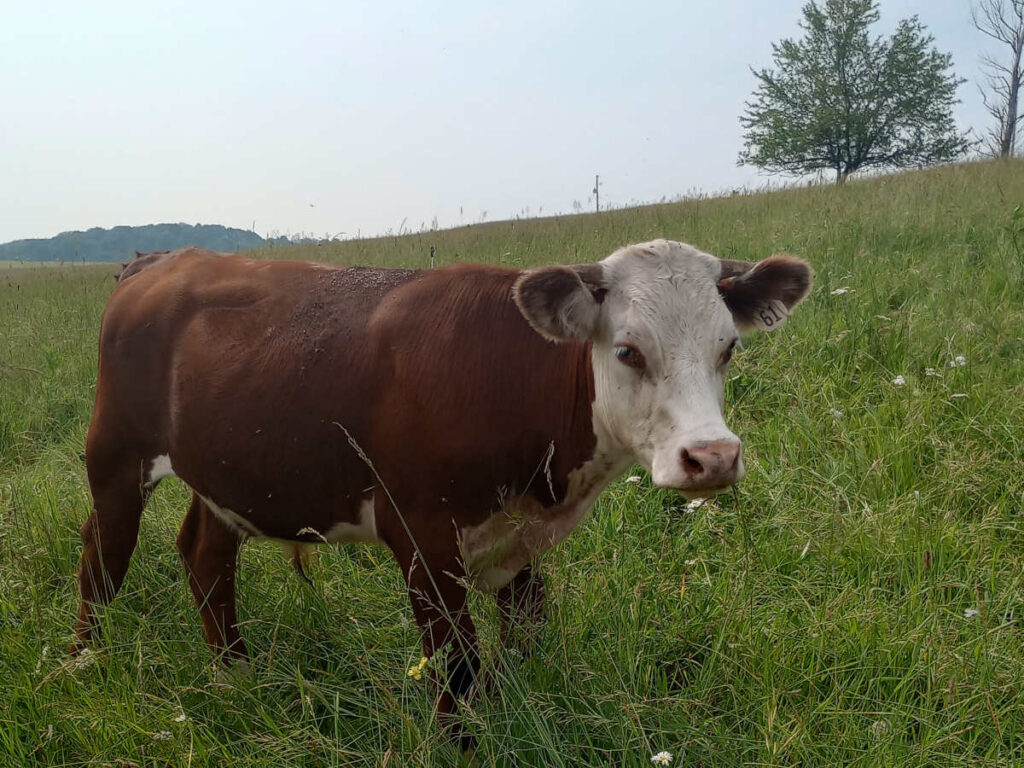
When Mercy’s prospective owner brought a yearling steer to the negotiating table, we leaned forward in our chairs. The deal was on.
So after adding Blossom on Sunday, listening to eight thousand moos on Monday, and welcoming fifty meat chickens on Tuesday . . .
We got ready to send with Mercy and Martha on their way, and add “Chuck” to our herd first thing Wednesday morning.
Introducing a new animal to the pasture, loading two onto a trailer, and bringing cows in and out for milking, all within the same hour or so, requires a bit of logistical forethought on the part of the farmer.
All things considered, everything went surprisingly smoothly, the only hitch coming with the introduction of Chuck.
We had thought the best strategy would probably be to shuttle him out to the field while the cows were penned near our milking shed. He’d have time to settle in, and then we’d bring his new herd mates to meet him.
Chuck didn’t like this plan.
He was more than reluctant to cross the creek into our main pasture. Indeed it took two people pulling on a rope, and two pushing hard from behind to kindly persuade him over.
But we had barely returned to the house after leaving him in the pasture when he came running down the hill, hopped through the creek with little hesitation, and trotted over to the milk shed to meet the rest of the herd.
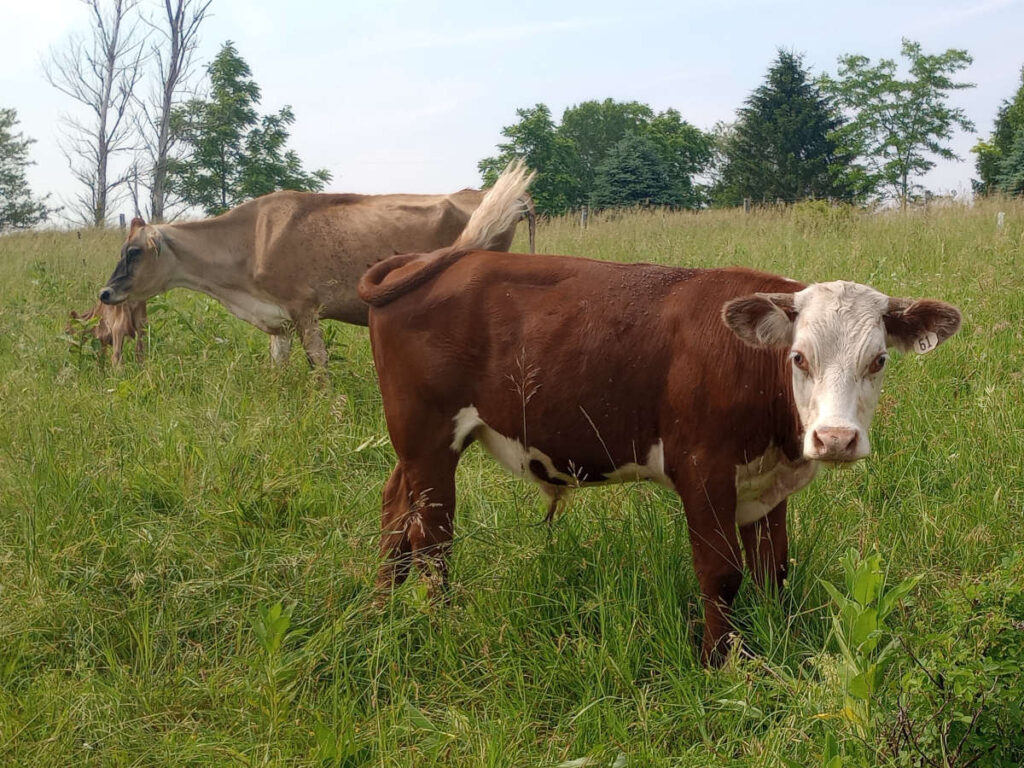
We had thought he was scared of our bridge and creek. This was probably true. But it also turned out that he is a friendly fellow, who just couldn’t wait to introduce himself to the ladies among whom he is fated to spend his remaining days.
When we brought him back to the pasture for a second time, this time with his new bovine companions, he was quite happy to go along.
And so beef and chicken production for the year is well underway, our dairy herd is once again a manageable size, and . . . we are still trying to situate Rosie to the satisfaction of all parties.
What a whirlwind.
For fear of making our narrative too long, we didn’t even go into the saga of marauding, tomato-eating deer that was playing out at the same time.
We plan to reward ourselves with a steak dinner, in anticipation of a much-larger-than-originally-anticipated quantity of beef hitting our freezers this winter.
In the meantime, we can only hope that our escapades have been as enjoyable to read about as they were for us to . . . live.
And here’s one more picture of Chuck. Just so we can all lick our lips one more time.



Chuck sure is a beefy guy! I wonder how much he eats… Congrats on the acquisition and on the safe delivery of Blossom. Never a dull moment at FBF!
Wow, wow and wow! Whew I’m exhausted to reading this!! Kudos to you all for making it through! 😉
Congratulations on all the additions to your farm family. You have done so much work!