

Improve On Your Lawnmower: Buy a Cow or a Sheep (Intensive Rotational Grazing Explained)
Here’s a secret: we’re not very good at keeping our lawn mowed. In fact, it is so far from manicured, that we might find ourselves having awkward conversations with concerned members of our HOA. If, that is, we lived in a “neighborhood.”
But if you were walking by our house one day and pointed your finger commenting: “Those people don’t care about their grass.” You’d be wrong.
We actually spend waaaay more time on our grass than even the proudest owner of a suburban zero-turn mower.
You see, our perspective on grass is not that of our hypothetical HOA committee.
It’s not simply a rather useless yard decoration whose maintenance can be inconvenient.
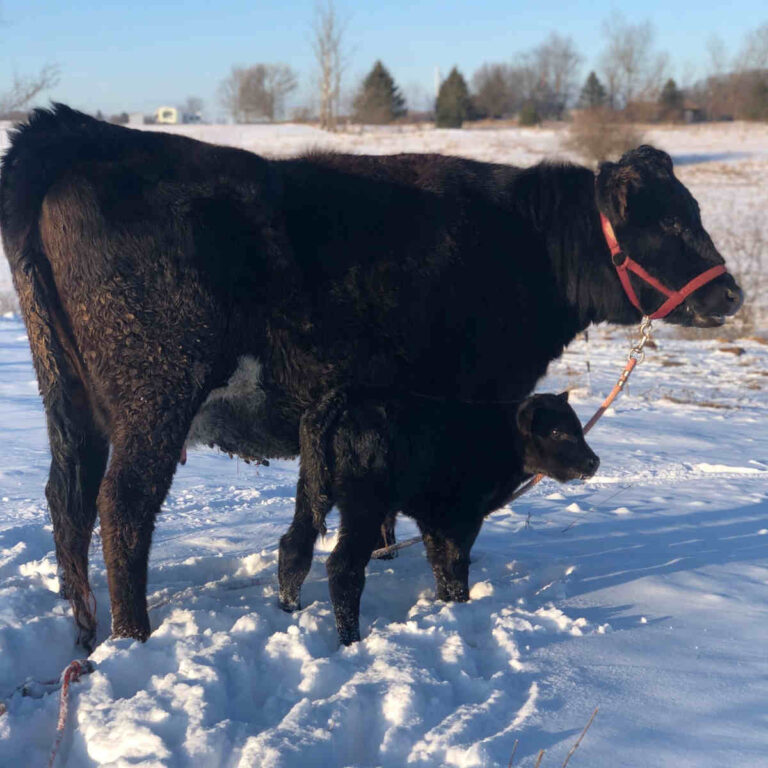
It’s an important food source for our animals (and by extension, for us). So much, in fact, do we consider it a food source, that when our lawnmower broke, we sort of abandoned it in our yard for a few months, and eventually let our cows in to do the job, patting ourselves on the back in satisfaction for a genius solution which both fed the cows for a few days and eliminated the task of fixing the lawnmower.
The fact is that during the “growing season” (spring-fall) we spend a great deal of effort getting our grass to grow as much as possible.
Now, if you came by one day and found Matthew (the pasture chief) engaged in “grass care,” he wouldn’t be riding a lawnmower. What he’d actually be doing would be moving electric fencing around to create temporary paddocks for our animals.
He does this every day.
With four years of practice, it’s usually a fairly smooth process at this point. But it can involve daunting tangles of braided polywire, or driving the four-wheeler all over the field to gather just enough fence posts. There’s even the risk of an occasional zap for the farmers if they happen to forget to turn things off (or if there is a breakdown in spousal communication).
“Why do you bother?” is a question we have received from friends, family members, and even concerned neighbors.
Well, here we are to explain.
Our management system is called Intensive Rotational Grazing.
The basic idea is to mimic the conditions in which grass, and other nutritious forage plants, will thrive in a natural ecosystem. Of course the Ingalls family, and all the other settlers like them, weren’t stumbling across electric fencing when they first arrived on the prairies. But it plays an important role in today’s regenerative grazing systems.

Grasslands in the Natural World
To explain the principles by which we manage our animals, we’ll take a trip back in history. To the time of buffalos roaming and deer and antelope playing, actually.
When the pioneers began settlement of the American Great Plains, they found some of the most amazing soil ever. It was so rich, and fertile, that they called it black gold.
For now, we’ll pass over the rant on how conventional agriculture is destroying what’s left of this soil.
Instead, we’re here to ask: how did it get there in the first place?
It was the grazing of large herds of wild ruminant animals that kept the Great Plains lush and fertile.
Imagine, for a moment, that you are a deer or a buffalo, roaming the unspoiled prairies in the 1800s.
Your food source is all around, right under your feet.
Your greatest threat is from predator attacks.
You certainly wouldn’t want to wander off all by yourself. You’d live with a large herd of other animals. Big enough to be daunting to the coyotes or even wolves that might be interested into turning you into a tasty meal.
With the constant threat of being eaten, you also wouldn’t stay in one place for long. With your herd, you’d find good grass. You’d eat it, and trample it, competing with your herd-mates for the best and tastiest morsels.
While you were there, you’d thoroughly fertilize then area. Then you would leave and not return to the same area for a long time.
After all, predators are known to lie in wait in an area where their prey is known to return repeatedly think their prey will return (think about all the drama that happens at watering-holes).
How did this natural grazing pattern create amazing soil?
For several reasons.
When a herd of animals grazed a certain area, they left behind large quantities of the nutrients needed for the plants to grow back.
The grasses and plants also had an extended period in which nothing was eating them, and they were able to grow back stronger and thicker than before.
Finally, the very process of being eaten strengthens plants and the soil they grow in. So long as there is a long enough recovery period, grazing serves the role of an invigorating pruning. Meanwhile, when grasses are grazed, their roots die back too. This process opens the door for an amazing amount of microbial activity in the soil, and introduces carbon, all of which helps to create amazing topsoil.
Nutritionists are discovering that microbes in the human body play a key role in overall health. The same could be said for soil and the farm. To farm our cows and our pasture right, we have to start by farming the microbes!

It’s worth nothing that other famous grasslands of the world have been formed in the same way. The African Serengeti, for example, is famous for the “Great Migration” of its Wildebeest and zebra herds. Millions of animals, following the rainfall pattern, engage in a year-long, 500 mile journey, which brings them back to their starting point just in time to begin all over again. Of course, they’re grazing hard and pooping all the way. And the grasses get a full year of rest before these very large herds return to them.
Keeping grazing animals in the same place year after year certainly doesn’t seem to be nature’s way. More importantly it leads to the depletion of soil and plants over time, which in turn reduces the nutrition available to animals, and to the humans eating the milk and meat that those animals produce.
But what’s a farmer to do without any wolf-packs to help him keep his cows on the move?
Imagine the wolf packs that used to roam the grasslands of this country fading into the mists of history. But what is that, taking their place? It’s starting to take shape . . . it looks like a person . . . Oh yes! It’s a regenerative farmer armed with a reel of polywire and some moveable fenceposts.
Seriously, our cows have it so much easier than the deer and the buffalo. It’s not as if this thoroughly modern “wolf” would try to kill and eat them.
Oh wait. . .
Well, at least he will make effort to ensure a quick and painless death.
Conventional Grazing Systems
The most common practice among farmers who are managing grazing herds today is to keep them in the same pasture for several weeks or even months at a time. The farm might be divided into several large areas, and the animals moved three or four time in a year.
Unfortunately, this practice, over time, will turn pasture into a desert.
Here’s why.
There aren’t any predators around to make the animals move along quickly to the next feeding spot.
In comparison with their wild forebears, our domesticated cows and sheep (who are lucky enough to have us to take care of them) are spoiled and lazy couch potatoes. With us and our fencing to keep them safe from predators, they have no reason to keep moving on to fresh pastures.
Also remember that cows should be thought of as 800 pound two-year-olds.
They happen to really like tender young shoots of newly regrowing plants.
Would your two-year-old eat jelly beans over and over and over again if given the opportunity?

Given the opportunity, they’ll return again and again to the same areas and the tastiest plants.
(Yes, apparently some kinds of grass are yummier than others. Who knew? We’ll take it from the cows. To us, as mentioned previously, one type of leaf tastes pretty much like another.)
In this type of situation, grazing does not serve its natural role of providing a beneficial pruning. Instead, it slowly kills delicate young plants through over consumption. Over time, conventionally managed cows will kill the most desirable and nutritious plants in the field, and damage the soils in which they are growing, leading to bare soil and grasses that are lacking in nutrition.
Of course then you can start feeding them grain. But we’d rather not.
Intensive Rotational Grazing
That’s why more and more farmers (like us) are turning to a system called Intensive Rotational Grazing.
Using our trusty friend, moveable electric fencing, we move our animals every single day to give them fresh pasture. Some farmers even move their animals twice a day, and see even greater benefits. But we don’t quite have time for that.
In addition to improving our pasture, this system is also good for animal health. A clear benefit is that they aren’t living in their own excrement. They’re much less likely to develop issues like parasite overload.
This system means that each particular patch of our pasture is only grazed for three or four days out of a year. The rest of the time is given to rest and regrowth.
Four years into this experiment, we can certainly say that we’re starting to see the effects, especially in combination with a strategic rolling-out of hay bales during the winter months, which seems to expedite the process of building topsoil.
Our strip-mined, clay soil, is starting to produce an abundance of thickly growing grasses and other nutritious forage plants.
So the end of this long conversation with our HOA is that yes, we really do care about our grass, despite how the yard may sometimes appear. Who would have thought we’d be spending so much time and effort, and (mental energy too!) on such simple things as grass and soil?
But really, managing your plants and your soil with care is “at the root” of any regenerative farming enterprise.

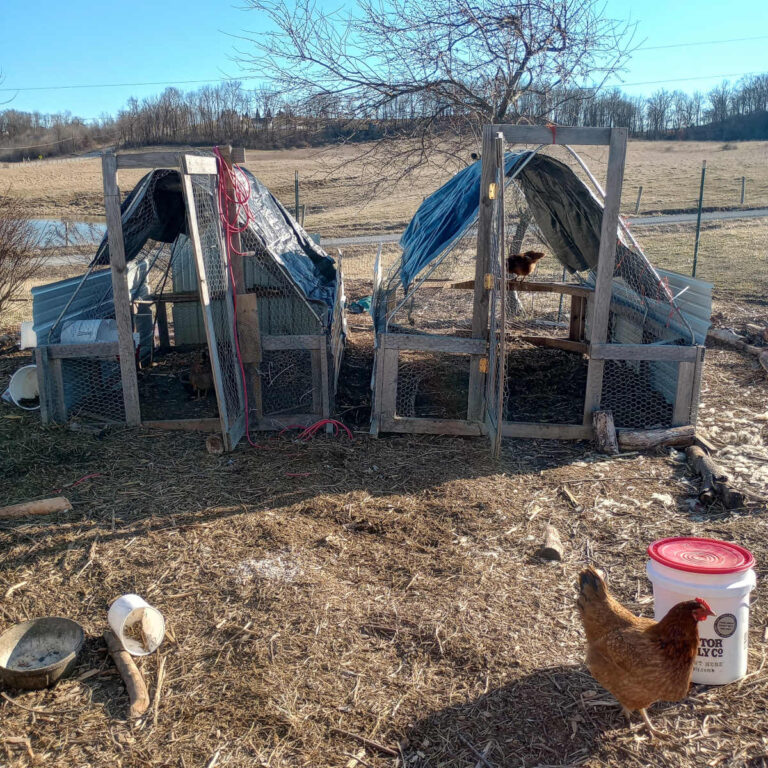
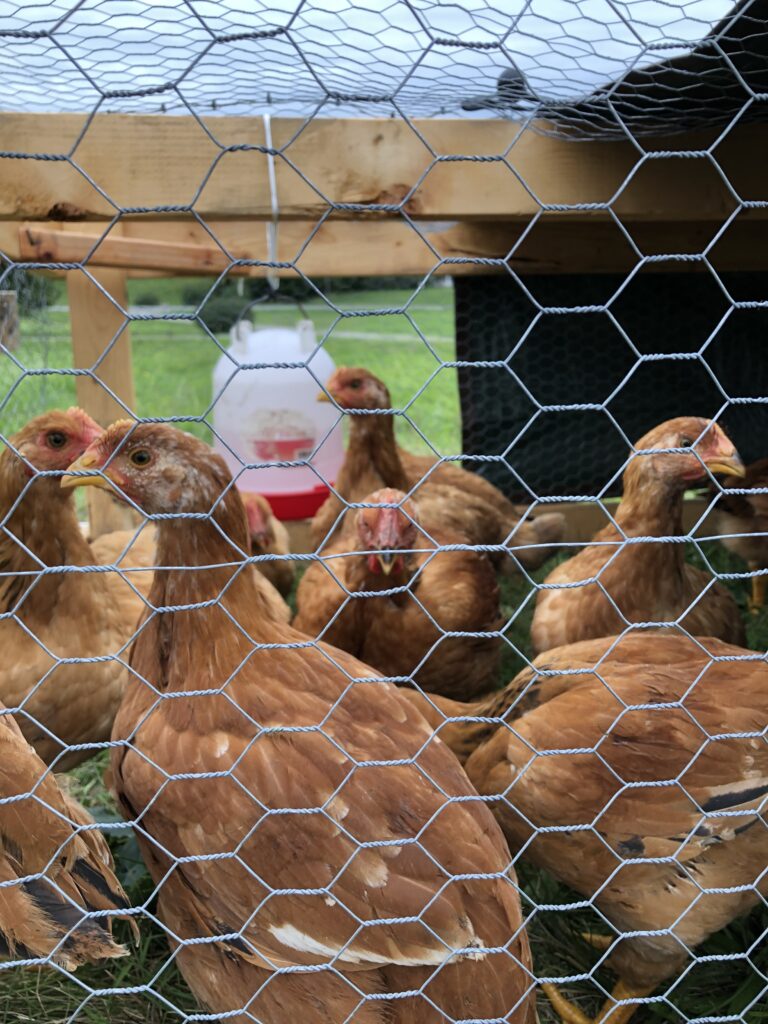
So smart! Does rotational grazing work for chickens too? And, if so, how do you protect them from predators? Do you use a moveable coop or some sort of shelter?
Yes, we use Suscovitch tractors to move them around, but there’s lots of different ways to do it. We keep ours in most of the day so we find the eggs, and let them out for a bit in the afternoons/evenings.