
Why You Might Want to Kill Your Calf at Birth (According to William Cobbett)
It’s time for another installment of “Homesteading with the Masters.” Today, we’re turning to classic agrarian author, William Cobbett, for some insights on how to manage our calves.
William Cobbett was an English writer, and held the distinction of opposing the Industrial Revolution in its early days. When many saw only the promise of wealth from the rapid development of factories and industrial towns, Cobbett had the foresight to champion rural living and to encourage people to hold on to the many benefits that might be found by supporting one’s family from the land.
His Cottage Economy is a classic agrarian work, in which he sets out some of the whys and wherefores of embracing rural life. He also gives a practical guide on the nitty gritty details of skills he considered essential for a family attempting to make a go of raising their own food. As he listed them, these skills included: “brewing Beer, making Bread, keeping Cows and Pigs, raising Poultry, and . . . other matters.”
Having experienced quite a few troubles in the managing of our dairy cows, we were eager to see what this revered farming writer might have to say on the topic and flipped quickly to the “keeping Cows” section. His words were surprising . . . but also validating.
What should you do with the calf of your dairy cow? Here’s what William Cobbett thinks.
(Warning: this quote was not written with modern sensibilities in mind.)
“Sometimes it may be the best way to sell the calf as soon as calved; at others, to fat it; and, at others, if you cannot sell it, which sometimes happens, to knock it on the head as soon as calved; for, where there is a family of small children, the price of a calf of two months old cannot be equal to the half of the value of the two months’ milk. It is pure weakness to call it “a pity.” It is a much greater pity to see hungry children crying for the milk that a calf is sucking to no useful purpose; and as to the cow and the calf, the one must lose her young, and the other its life, after all; and the respite only makes an addition to the suffering of both.”
William Cobbett, The Cottage Economy, first published 1821.
Hold on. Did he really just say that? It might be best to go ahead and kill your newborn calf if you have nothing better to do with it?
Is this a classic agrarian text, or just a more disturbing version of Bambi?
What could an calf possibly do to so provoke the ire of the farmer?
Well, quite a lot actually, and “sucking milk to no useful purpose” sums it up pretty well.
We are now a whopping seven calves into farming, and we have to admit that this no-nonsense take on baby animal ownership does have its merits.
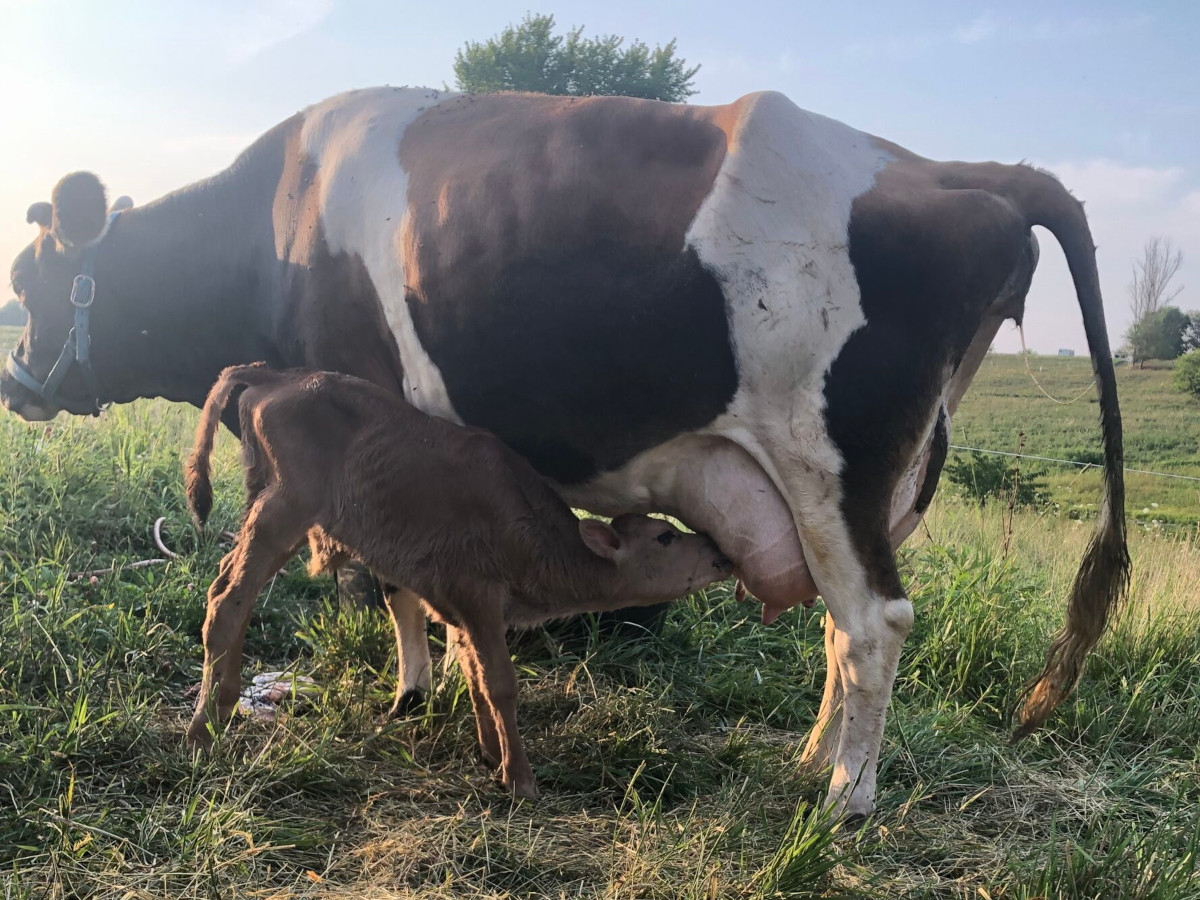
First, let’s outline a basic-but-often-overlooked principle. The relationship between the would-be human milkers of a dairy animal and the natural offspring of said dairy animal is . . . inherently . . . competitive. You both want the same milk. The cow usually doesn’t mind giving her milk to the farmer, but given the option would rather give it to her own baby. Hence sad conflict arises between farmers and their calves.
There is no clench-your-fist moment quite like stepping out eagerly in the morning, milk-pails a-clanking, only to be greeted by a flabby, empty, udder, and a calf gloating triumphantly over you. He’s evaded the complex obstacle system you set up to keep him from his mother once again.
Time for some real life stories from the farm:
Penny: the Original Thorn in Our Sides
Fully explaining our calf-management struggles requires a trip back in time to 2021 and the first calf we ever welcomed to the farm: Pentecost (nicknamed Penny). He came as part of a package deal with his mother, Gemma, our first milk cow.
There is a lot to be said for buying a cow with her calf “under her” for your first dairy cow. Having the calf allows for the possibility of taking breaks in the otherwise daunting-to-the-new-farmer prospect of milking every single day. It’s also to be expected that you will not be great at milking when you first start. Have the calf to empty the cow’s udder after you’ve done your best is a good way to protect the cow from developing an infection due to lack of skill on the part of the farmer.
So we were happy to welcome Pentecost to Friendly Beasts Farm, and might even have mentioned that he was “cute” when he first stepped off the trailer with his rather frazzled mother.
Little did we know. . .
The clue was in the name, people.
We missed it.
But we should have been forewarned that owning him was going to be a baptism of fire in calf ownership.
Yes, Penny certainly introduced us to all the drawbacks of sharing your cow with her calf (also known as calf-sharing).
“We’ll just take him away at night so we can get milk in the morning” we told each other, not to mention any family or friends who might be questioning our sanity for taking the plunge into cow ownership so soon after buying our homestead. “When we need to take a break or go on a trip, we’ll leave them together.”
The unanticipated difficulties came with the “just take him away at night” part of this plan. It is surprisingly difficult for two inexperienced people to separate two animals who would rather stay together. It is particularly challenging when these animals are bigger, stronger, and can run faster than you can.
The details of many of Penny’s various escapades have mercifully faded into the mists of memory. They’re probably repressed somewhere, actually, with all the other traumatic incidents of our lives.
Let’s just say, he was the worst.
Our next-door neighbor, who had grown up on an dairy farm and was the frequent and thoroughly amused spectator of our efforts, even when so far as to nickname him “The Beast.”
Looking back to those early days, we only have a vague sense of Penny, on multiple occasions, appearing out of the morning mists side-by-side with his mother, he full-bellied, she of empty udder. And all this after we had spent a good hour the night before trying to catch him.
Triple stranded pen of electric fencing? He broke out of it before we even got back inside our house.
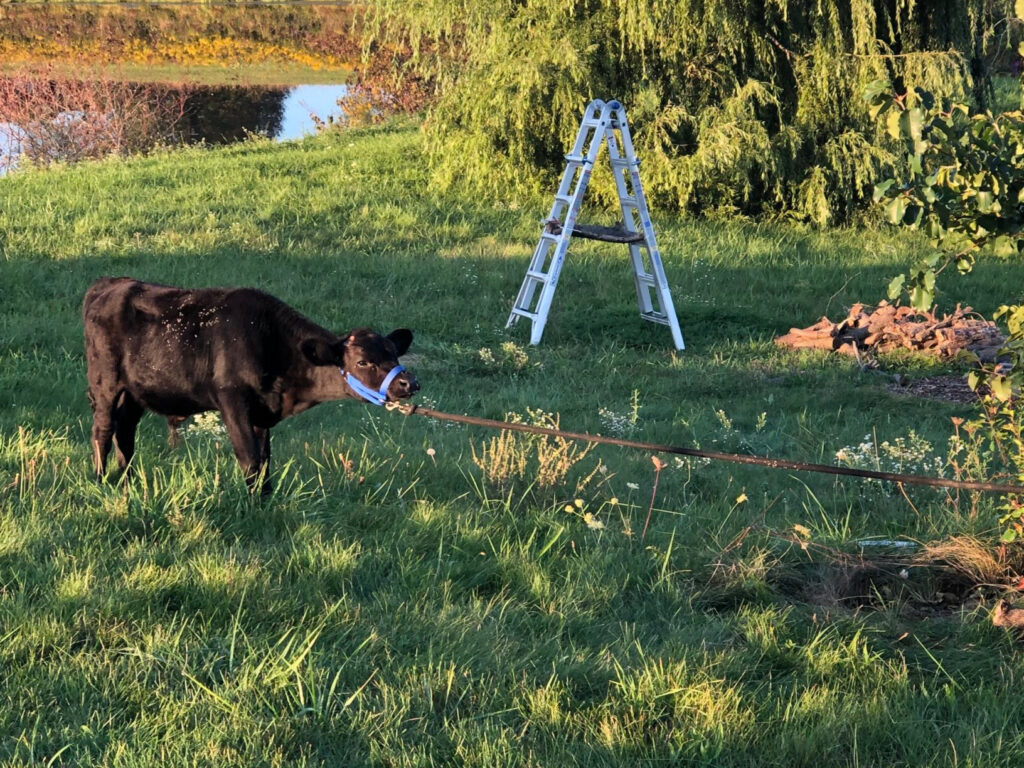
Halter tied to a tree? The halter was found dangling mysteriously empty. What??
This also all happened before we put up perimeter fencing on our farm, so many of our Penny chases took us not only all around our own property, but even up and down our (quiet, country) street.
We eventually got a halter securely attached to him, and built a pen in our milking shed where he could reliably spend the night. But it still took two adults and more than a few frustrated minutes to bring him in every night. With one of us pulling from the front, one pushing/slapping from behind, and Penny in the middle, we looked like a picture of “how not to manage your calf.”
Calf-sharing. It’s great. You’ve got to try it. Makes dairy farming so easy.
Mercy: Dig-Your-Feet-In-And-Refuse-to-Budge
“Well,” we thought, “Calf-sharing is probably still a good way to go. After all, by the time we met Penny he was three months old. With Gemma’s next calf, it will be different. We’ll meet her at birth. We’ll pet her, and feed her out of our hands, and lead her around with a rope, and she’ll just love us and be super easy to catch every night.”
Wrong.
About six months later Mercy, of whom we have written more here and here, made her appearance one spring morning.
We should have named her Stubborn instead.
We petted her and loved her. At least we tried. But our hurried efforts amid all the other tasks of caring for small children and getting a new farm up and running weren’t enough to win her over.
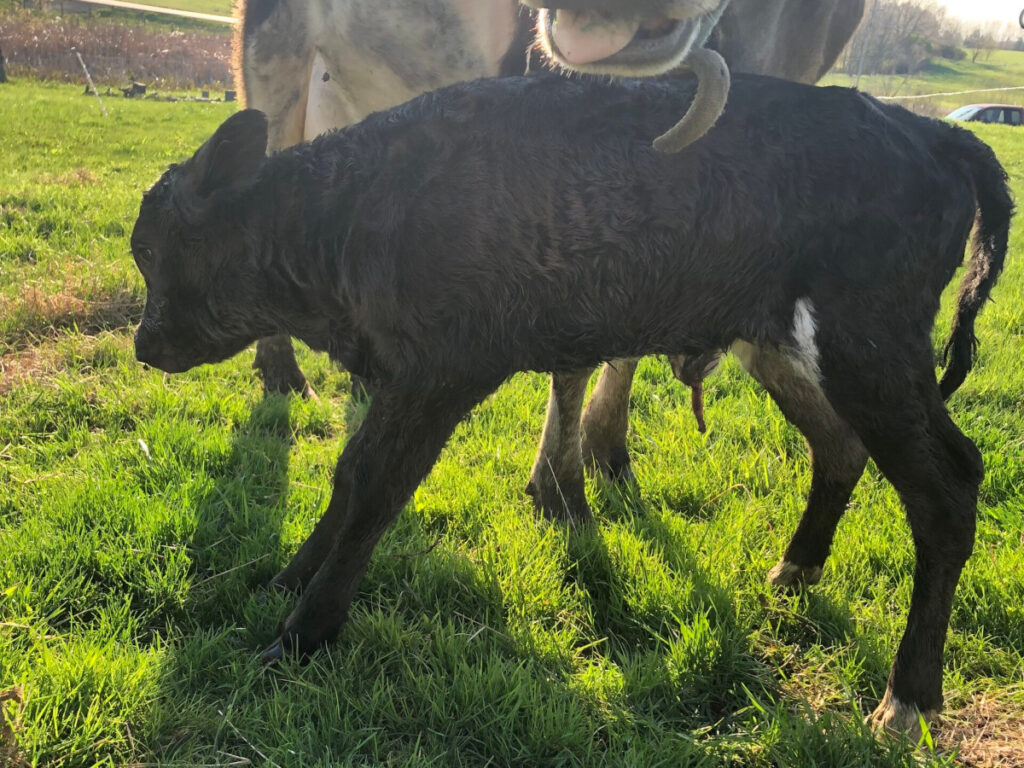
We also thought that if we put a halter on her and started leading her around from a young age, she would never be so much of a pain as her brother. Maybe we just didn’t know what we were doing. Or maybe Mercy didn’t have a personality suitable for halter training.
We would put a halter on her and lead her, either by hand or with her tied to our fourwheeler (when she proved stubborn).
Mercy made it clear that she had no interest in learning to walk with a halter. She would literally roll her eyes back, stick out her lower lip, plant her feet, and allow us to drag her through the mud rather than take one step of her own accord. Even when we were pulling her with the four-wheeler.
She was, at least, less of an escape artist than Penny, and easier to keep away from her mama. But the joys of a simple and stress-free calf-sharing relationship still eluded us.
And So It Continued
This is meant to be more of a highlight reel of our calf-sharing woes, rather than a slog through every detail, so we’ll pass quickly our next few attempts, giving only honorable mention to Daisy, who became buddies with our farm dog Tilly, which was awfully cute until they started teaching each other how to get out of the fence, and Brisket, whom we thought we castrated but turned out to be very much still a bull. In fact, calf management is a great example of the 99-1-9-10 rule of farming. If you give them the smallest chance to defy you, they’ll take it and more.
A Change in Methods
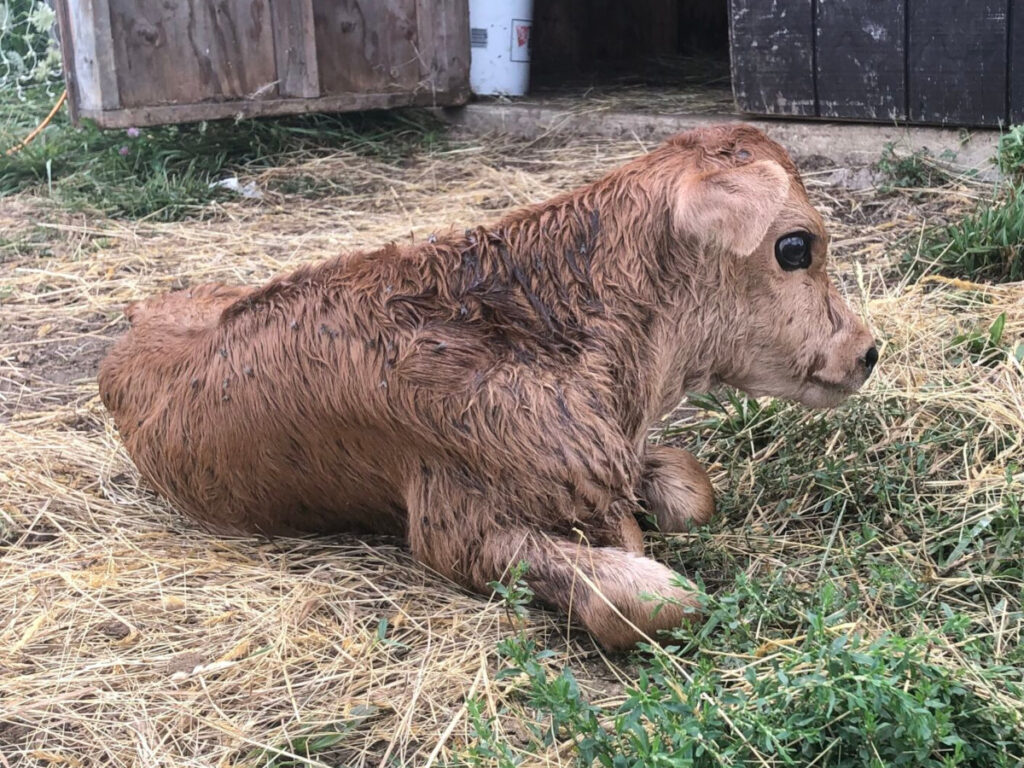
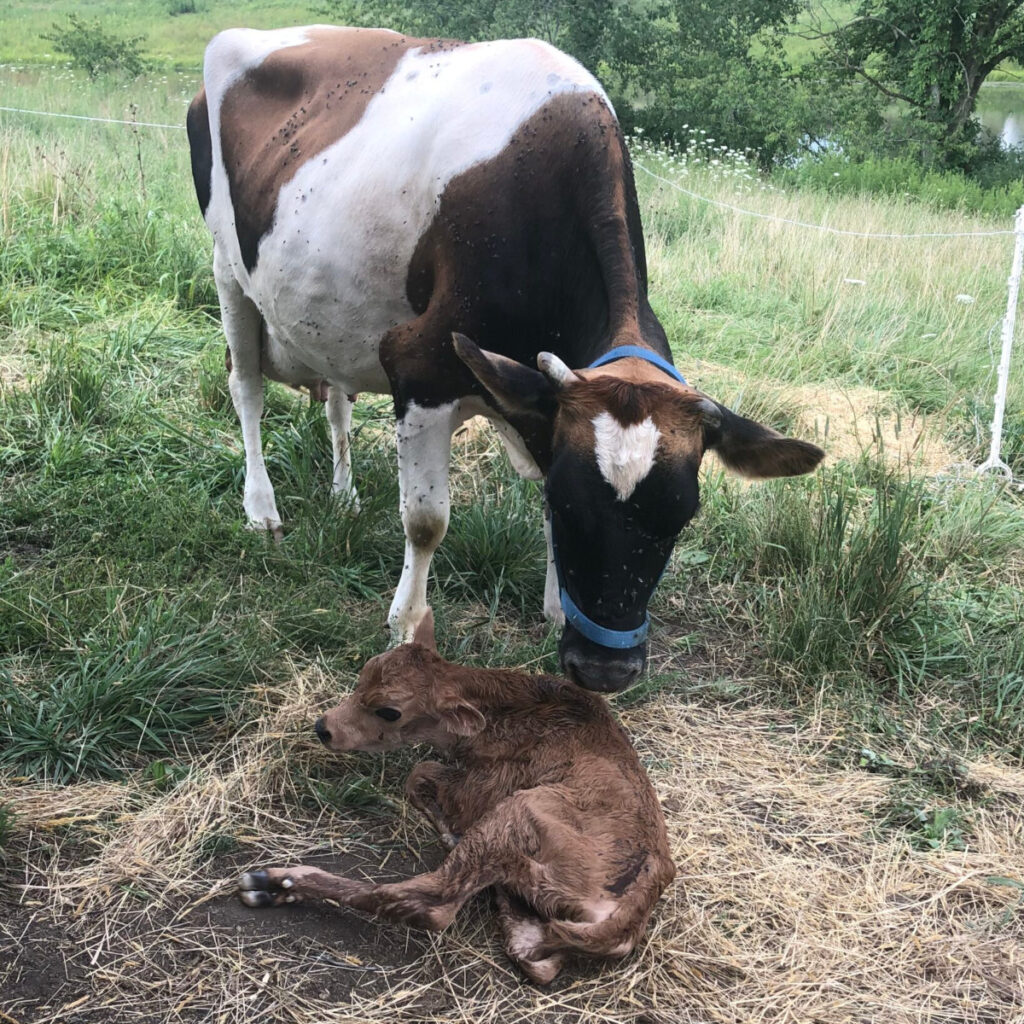
With our most recent addition, we finally threw up our hands and gave up on calf sharing. We separated Blossom from her mother (Clover) within a week of her birth, and have been bottle feeding her twice a day.
Bottle feeding twice a day? Sounds like a lot of work!!
Actually, it isn’t.
We’ve replaced a job (separating the calf) that required two adults and a fair amount of frustration, with a task (bottle-feeding the calf) that can be enjoyably completed by an unaided seven-year-old.
Wins all around.
Oh, and Clover doesn’t even seem to care that much.
The only sad part is watching Blossom “suck down” a gallon of milk every day.
We should add the footnote that we were emboldened to make this decision by the presence of a neighbor with whom we can trade farm-sitting, thus making the “take-a-break-when-you-want-it” aspect of calf-sharing feel like less of necessity.
Back to William Cobbett
And with that we return to our opening quote. Should you really think about killing your newborn calf at birth?
Well, we’ll admit to the “weakness” of thinking that it would be a bit of “a pity” to slaughter a calf at birth.
That said, we are unlikely to be in the position suggested by William Cobbett of having an entirely useless calf on our hands.
We should be able to sell any calf we don’t want to keep, or “fat it” for our meat stores (Cobbett’s other two options).
Nevertheless, we wholeheartedly agree that there are more than a few things to be said in favor of getting the calf “out of the picture” in one way or another in a timely fashion.
Separating Blossom fully from her mother has certainly made our lives easier.
We might also add that our discovery of this passage in The Cottage Economy was quite heartening.
With all our calf-sharing troubles, we might have suspected that we were doing something wrong.
But to write these lines, Mr. Cobbett must have been equally frustrated with his calf, on at least one occasion.
And if he experienced these struggles, they must be quite normal, for he must have been a much better at farming than your friends at Friendly Beasts Farm.


We love your creative naming of your calves! So cute … until they’re not! 😂